

SYNESTHESIA
When The Prism Leaks

The Leak in the Prism
The world enters us divided light, sound, touch, taste, smell each sense a separate beam.
Yet something in us insists these beams belong together.
Every time you see a color, hear a chord, or feel a heartbeat, your brain performs a quiet miracle:
it binds a thousand fragments of sensation into one seamless “now.”
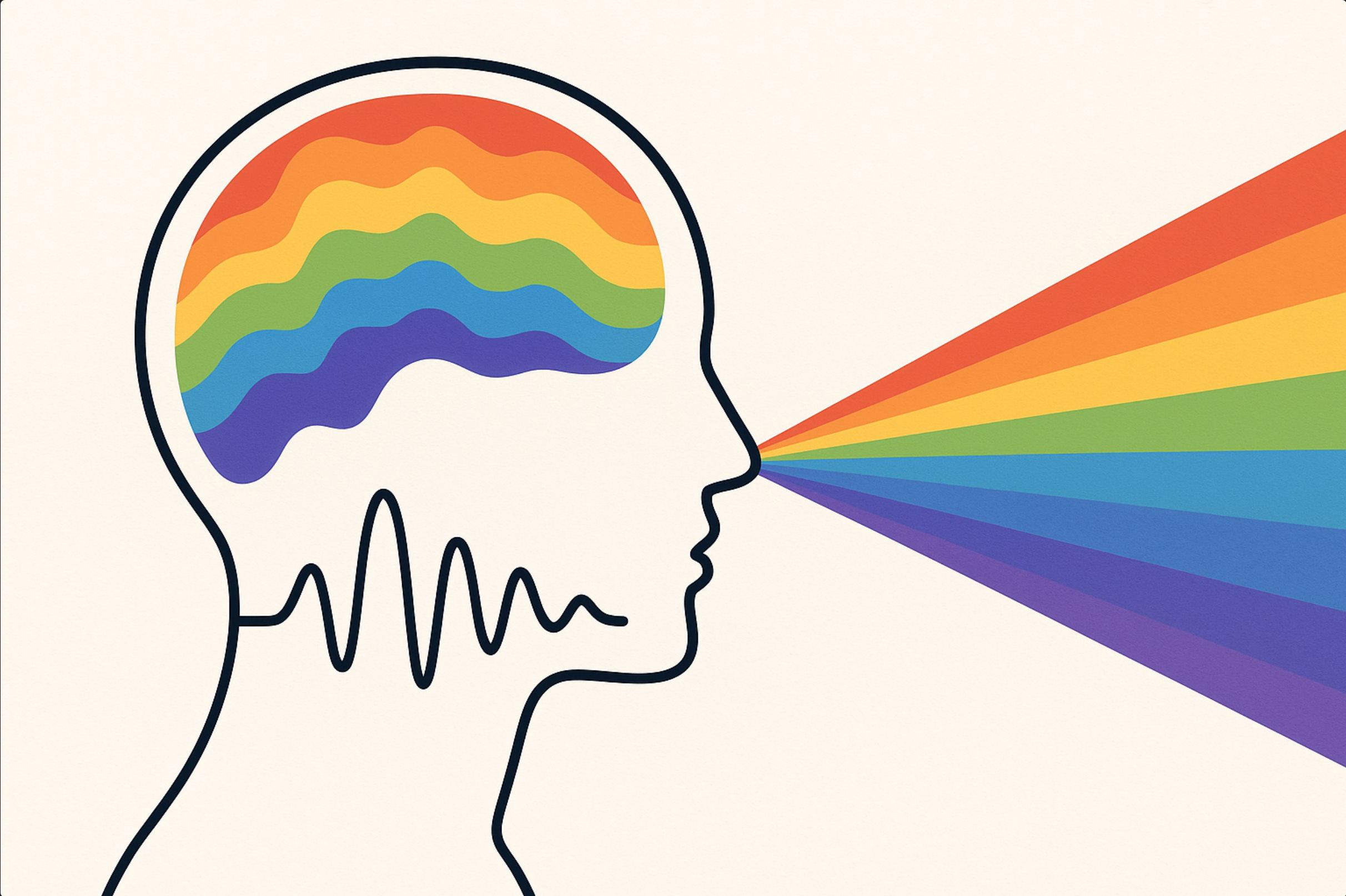
But sometimes for a few the prism leaks.
Color bleeds into sound, sound drips into shape, and the senses cross like rivers meeting in flood.
That is synesthesia.
Science of the Leaking Prism
To the neuroscientist, synesthesia is when one sensory pathway lights up another.
See a letter, and a color appears.
Hear a note, and a shape unfolds.
Taste a number, and sweetness rises in the mind.
It’s not madness; it’s cross-wiring.
Functional MRI scans show that synesthetes’ brains have extra bridges the visual cortex talking to the auditory, the tactile whispering to the gustatory.
But look closer, and you realize: these bridges are not alien.
They exist in all of us only usually gated, dimmed, separated by filters.
The Brain as a Prism of Unity
The brain is a prism that takes the white light of reality and splits it into the colors of sensation vision, hearing, taste, touch, smell.
Synesthesia is when a crack forms in that prism, and the white light begins to seep back through.
It is not an error, but a revelation of how unity hides inside diversity.
It whispers, “The senses were never meant to be strangers.”
Metaphysical Glimpses
Mystics have long described experiences that sound like synesthesia
seeing music as color,
tasting prayer as sweetness,
feeling the divine as warmth.
For them, the senses were never truly separate.
They were different languages of the same consciousness.
The Sufis called this crossing jamal, the beauty that fuses form and sound.
In Christian mysticism, saints spoke of the “light that sings.”
Even Plato suggested that the soul once perceived all things in unity before being divided by incarnation.
Perhaps synesthesia is not a glitch but a memory.
Psychology of Integration
In the ordinary mind, each sense keeps its distance.
The intellect names, the emotion feels, the will acts.
But in moments of art, love, or transcendence, the walls thin.
You can see harmony, taste joy, hear light.
Keep reading with a 7-day free trial
Subscribe to Sensory Cafe♨️ to keep reading this post and get 7 days of free access to the full post archives.