
WHEN THE MIND IS NOT ALONE
THE FIELD OF CONSCIOUSNESS

There is something about showers that loosens thought.
Maybe it’s the rhythm of the water, maybe it’s the temporary silence from the world, or maybe it’s the simple fact that the body is relaxed enough for ideas to move without resistance.
That morning I wasn’t trying to think about consciousness.
I was thinking about nothing.
But as the water ran over my shoulders, something small caught my attention. My hand moved to adjust the temperature before I had consciously decided to move it.
It was automatic.
My body had already acted.
Then the realization appeared a moment later:
“I didn’t think about that… my body did.”
And suddenly that earlier idea from the previous chapter returned:

What if thinking does not begin in the brain?
What if the brain is only part of a larger process?
The thought lingered there in the steam-filled air.
If the body can act before thought appears, then the mind cannot be confined to the head alone. The organism itself is already participating in intelligence.
But another question quickly followed.
If the body participates in thought…
And if our bodies constantly respond to other bodies…
Then where does consciousness actually begin?
Inside us?
Or between us?
That question is where the deeper frontier begins.
Synesthesia suggests that consciousness is not rigidly divided into separate channels of perception but operates as an integrated field of experience, where senses, body and meaning can blend together, revealing how awareness may arise from the interconnected patterns of the whole nervous system rather than isolated processes within the brain; just as in Chromesthesia, Grapheme-color synesthesia etc..
WHEN MINDS MEET
Watch two people in conversation.
Something subtle begins to happen almost immediately.
One leans forward.
The other adjusts posture.
Hands begin to mirror gestures.
Breathing rhythms quietly synchronize.
Neither person decides to do this.
It simply happens.
Psychologists call this Interpersonal Synchrony the spontaneous coordination of bodies during communication.
Walk beside someone long enough and your steps begin to match.
Sit across from a friend and your gestures begin to echo each other.
In group settings, even heart rhythms can begin to align.
Multiple nervous systems start behaving less like separate machines and more like a coordinated system.
Understanding begins beneath language.
Before the sentence finishes, the body already knows.
THE NERVOUS SYSTEM THAT UNDERSTANDS ACTION
Part of this coordination comes from a remarkable neural mechanism known as MIRROR NEURONS, discovered by neuroscientist Giacomo Rizzolatti and his colleagues.
These neurons activate not only when you perform an action, but also when you observe someone else performing it.
Watch someone reach for a cup.
The motor areas of your brain partially activate as if you were reaching for it yourself.
Your nervous system is quietly simulating the other person’s movement in real time.
Understanding, then, does not begin with reasoning.
It begins with EMBODIED RESONANCE.
Communication is less like transmitting information across distance and more like two systems entering alignment.
FROM EMBODIED MIND TO PARTICIPATORY MIND
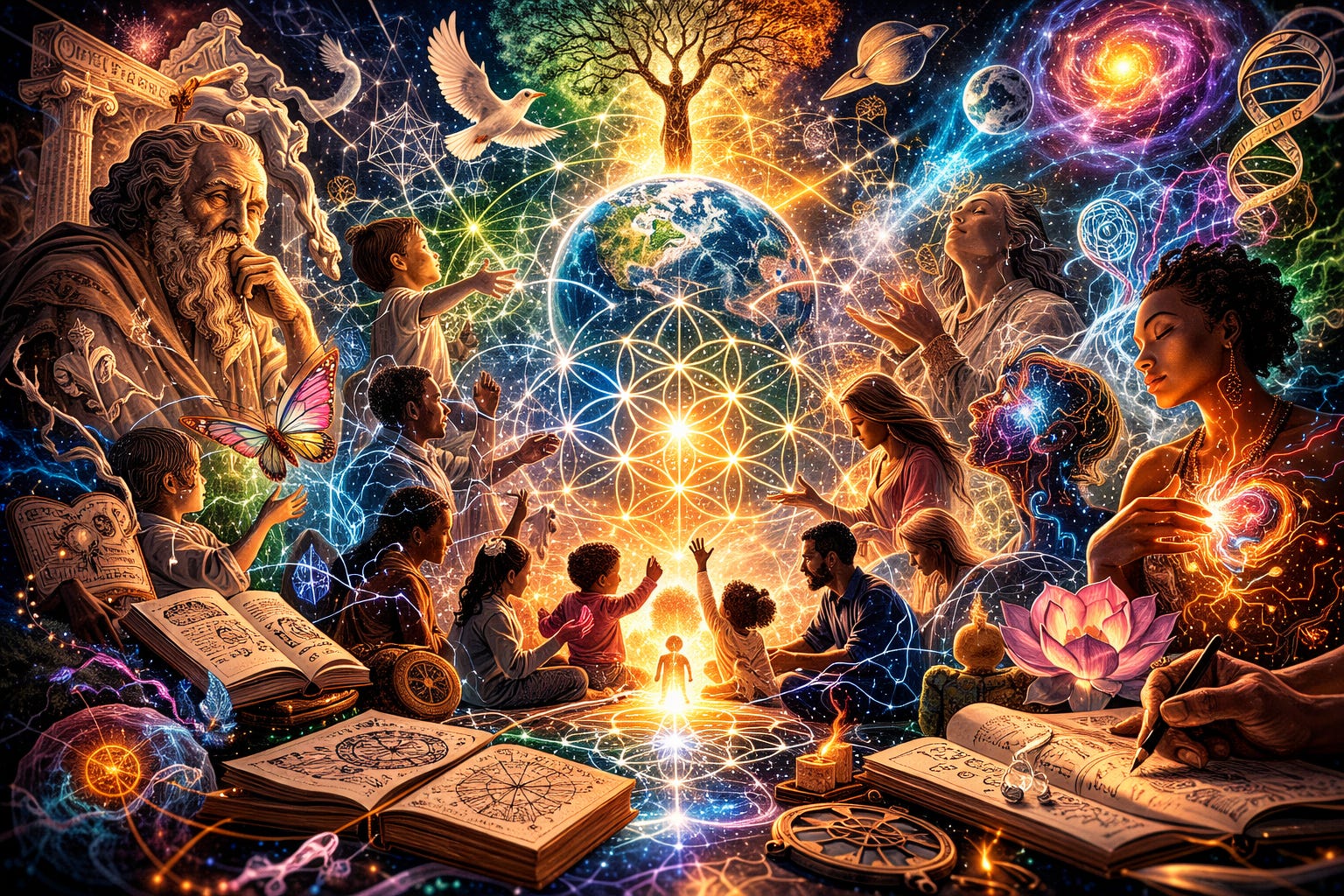
Modern cognitive science already points toward this shift.
Fields like Embodied Cognition and Enactivism argue that thinking is not confined to the brain.
Instead, cognition emerges through the interaction of brain, body and environment.
Once interaction becomes central, the boundary of the mind begins to blur.
The mind may not be something sealed inside an individual organism.
It may be something that emerges through participation.
The physicist John Archibald Wheeler once suggested a radical possibility: a participatory universe.
Observers are not merely watching reality.
They are part of the process through which reality unfolds.
Perception is not passive observation; It is engagement.
THE NETWORK BENEATH CONSCIOUSNESS
Seen from this perspective, human consciousness begins to resemble a network.
Each nervous system becomes a node.
Gestures, voices, expressions and movements form the connections.
Information flows not only through words but through posture, rhythm, timing and tone.
During a conversation, multiple minds coordinate in real time.
Something remarkable happens in that coordination.
Ideas appear that did not belong to either person alone.
They emerge within the interaction itself.
Group creativity works this way.
So does musical improvisation.
So do many scientific discoveries.
What appears to be individual thinking often turns out to be the visible edge of a much larger collective process.
THE METAPHYSICAL QUESTION
At this point, the discussion crosses into philosophy.
Specifically, into Metaphysics.
Science describes mechanisms.
Metaphysics asks what those mechanisms imply about reality itself.
What is consciousness?
Why does experience exist?
How does awareness arise from matter?
If cognition emerges through interaction…
if perception is participation…
if multiple minds synchronize into coordinated systems…
then consciousness may not be merely an internal property of individuals.
It may be a relational phenomenon, something that arises wherever systems interact and regulate themselves together.
The body is one level of this organization, Human societies may be another.
THE PATTERN THE MYSTICS NOTICED
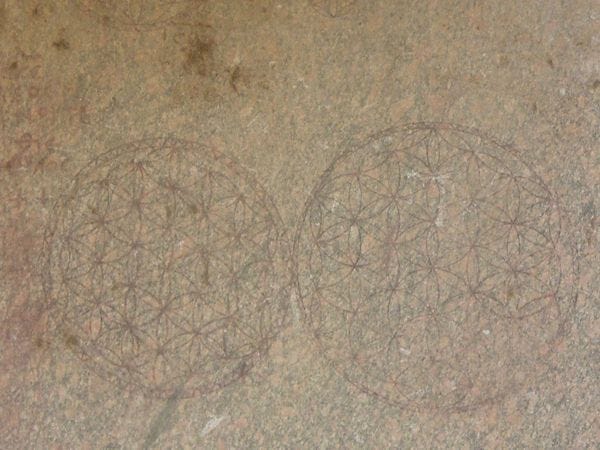
Across many spiritual traditions there appears a geometric symbol known as the Flower of Life. At first glance it is simple: a lattice of evenly spaced circles, each one emerging from the center of another. Yet the pattern quietly illustrates something profound about relationship and emergence.
Unlike a single shape drawn in isolation, the Flower of Life is built entirely from overlap and repetition. Each circle exists because another circle came before it. The pattern grows outward through connection. Remove the relationships and the structure disappears.
For many mystics, this geometry became a metaphor for reality itself.
In ancient temples of Abydos, engravings of this pattern appear carved into stone. Variations of similar geometric structures also appear in sacred art within Hinduism, Buddhism and later within mystical strands of Judaism and Islam. Across cultures separated by geography and time, the same intuition emerges: existence unfolds through pattern, relationship and symmetry.
Keep reading with a 7-day free trial
Subscribe to Easy Weezy to keep reading this post and get 7 days of free access to the full post archives.