

IMAGINATION TAX
And the Alchemy That Pays It Back


A Collab between Easy Weezy & MJ Polk:- Where the diagnosis meets the remedy and both get challenged
There is a sound the mind makes when it is doing it.
Not a sound exactly, a tightening. A pull.
The way a future that hasn’t arrived can already feel heavy.
Already feel textured.
Already press against the present moment like it belongs here.
Nothing has happened.
Yet something is already being felt.
“The mind does not wait for reality. It rehearses it.”
This is where we begin.
Not at the symptom but at the strange, unsettling fact that we are capable of suffering events that do not yet exist and often, events that never will.
We want to sit inside that fact together.
To name it.
To challenge it.
And then hand you something you can actually use.
Because a diagnosis without a remedy is just elegant suffering.
The Tax Nobody Told You About
As a student of Eclecticism, I often find the Stoics practical approach to philosophical questions appealing. So when I saw my friend and fellow Substacker, Easy Weezy post this Note on Imagination Tax, I just couldn’t help myself!
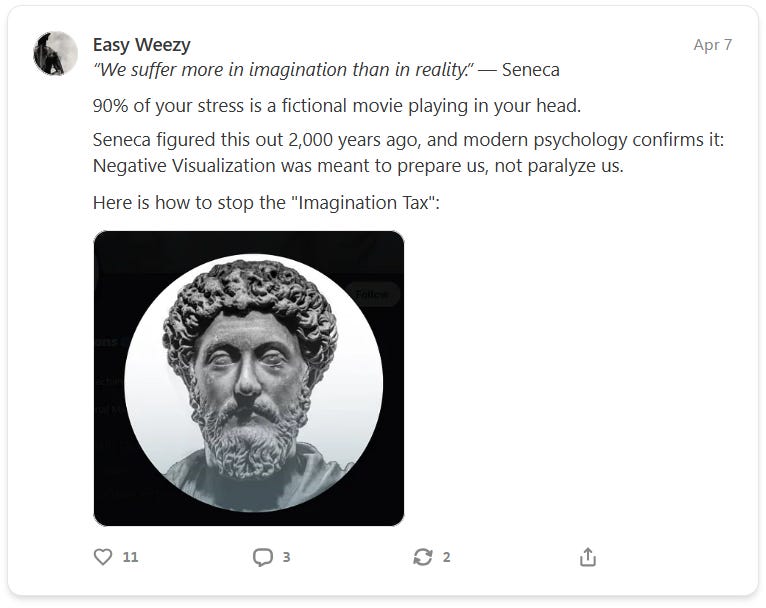
I had no idea where this was headed. I figured I’d write a little essay on the destructive force of ruminating on the future. I thought that with Weezy’s polished, scientific approach. And my no-nonsense way of attacking a challenge, we would really make a great team. Though, I wasn’t really sure how. I’ve not done a formal essay collab with anyone before. TBH- I’m pretty intimidated by most of you.
Then the very next morning I received a gift from Weezy. He was way ahead of me! And as I began reading his explanation of Imagination Tax, a remedy immediately emerged. And it’s probably the last thing you’d expect me to recommend…
Imagination Tax: the emotional and physiological price we pay for realities that have not arrived.
You feel it when:
A conversation hasn’t happened, but you’ve lived through it ten times
Failure hasn’t occurred, but your body has already reacted
A threat exists only in thought, yet your chest tightens as if it’s real
Science confirms what intuition whispers:
The brain does not clearly distinguish between imagined danger and real danger.
So imagined pain produces real consequences.
Ask yourself, honestly:
How many times today have you already paid
for something that hasn’t happened yet?
Long before neuroscience, Seneca saw it clearly:
“We suffer more in imagination than in reality.”
Not comfort.
A diagnosis.
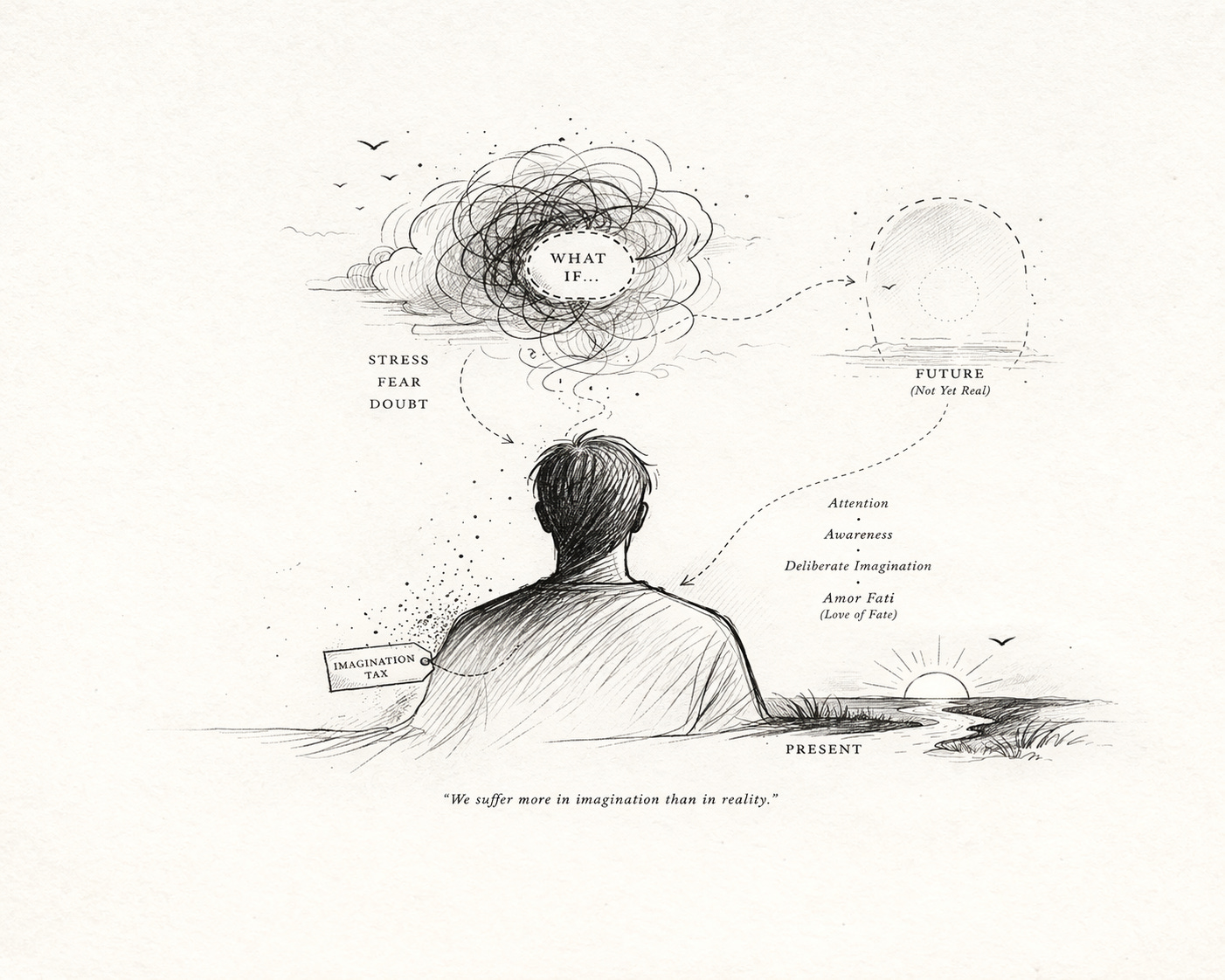
The Challenge:-Imagination Is Not the Enemy
Here’s where we need to be precise.
Imagination is not failing you.
Imagination:
Built civilizations
Created art
Imagined futures worth living into
“The problem is not imagination. The problem is imagination without direction.”
A hammer does not ruin a wall. A hammer swinging in an empty room, unguided, unwitnessed, with no one at the handle, ruins the wall. The mind's simulation engine is extraordinary precisely because it can project forward into possibility. The tax is not levied by that power. It is levied by that power running on autopilot, with no conductor, in a theatre where you forgot you owned the stage.
So the question shifts from:
How do I stop overthinking?
To:
Who is directing my imagination right now?
Because if you don’t know
something else is.
Attention:- The Gatekeeper Nobody Introduced You To
This is where Attention as Alchemy enters the room. You can read the post for more insight;

The piece asked a question that doesn’t announce itself as radical, but is:
“If where we place our attention shapes reality what shapes where we place our attention?”
Before imagination runs, something else moves first:
Attention.
There are two kinds:
Attention you place
Attention that is pulled from you
Most people believe they are doing the first.
They are mostly experiencing the second.
We live in an environment engineered for:
Distraction
Stimulation
Capture
So even your anxiety may not be entirely yours.
“What you attend to, you activate. What you activate, you amplify.”
Neuroscience calls this experience-dependent plasticity:
The brain reshapes itself based on what it repeatedly attends to.
So ask, slowly:
Who benefits from my attention right now?
That question alone can return you to authorship.
The Stoic Insight And Its Missing Condition
The Stoics didn’t just observe the problem.
They offered a method.
The Stoic art of the Premeditation of Evils, can help you dismiss them from the loop lessening any Imagination Tax incurred.
“There is no need to continue to fret about this, because I already know how I will handle it. I am prepared.”
Premeditatio malorum, or Premeditation of Evils, is the Stoic practice of intentionally imagining potential future misfortunes: like loss, health issues, or failure, to build resilience and gratitude. By anticipating challenges, practitioners reduce anxiety and prepare to handle adversity without surprise. It is not fatalism, but rather proactive, intentional visualization.
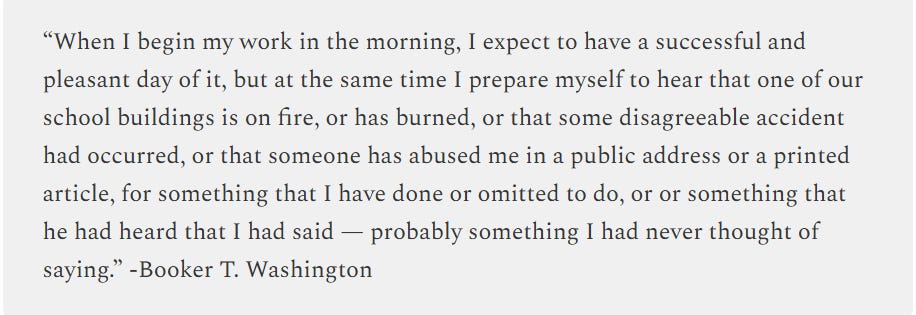
Booker T. Washington practiced this daily — calmly expecting disruption, not to suffer, but to remove surprise.
Marcus Aurelius did it before the world could interrupt him.
The principle is simple:
“If you have already faced it in clarity, it loses its power in uncertainty.”
But here’s the complication:
The Stoics practiced in environments without constant cognitive intrusion.
We don’t.
So the method still works, but only if something comes first:
Reclaimed attention.
Without it:
You are imagining without intention
Preparing without clarity
Looping without awareness
The tool is powerful.
But only in steady hands.
The Loop:- How Suffering Builds Itself
Let’s make it plain:
Attention fixates on uncertainty
The mind fills the gap with possibility
Possibility leans negative (for survival)
The body reacts (stress, tension, anxiety)
The feeling reinforces the thought
And the cycle repeats.
“You do not fear the future, you rehearse it.”
Rehearsal is not neutral.
It is practice.
Where Philosophy Meets the Body
This is not abstract.
Stress hormones rise during imagined threats
The same neural pathways activate for real and imagined pain
Chronic overthinking produces real physical strain
“Imagined suffering becomes biological reality.”
The event may not exist.
The cost does.
Amor Fati:- The Shift
Then comes something deeper.
Amor Fati: Loving one’s fate and acceptance of natural order.
Acceptance of Fate: Rather than wishing for events to happen as you want, wish for them to happen as they do. This means accepting challenges, hardships, and successes alike, recognizing them as unavoidable parts of the cosmic whole.
Focus on Response: Stoics believe that while we cannot control external events, we have total control over our internal responses, perceptions, and judgments.
MJ Polk -I have Amor Fati tattooed on me for a reason. It’s a constant reminder that one cannot love fate and worry about it at the same time. If I know that everything that happens is part of my path, there can be no worry over the potential of it. If I drop my judgment of events, there is no stressing over them. So when we can truly accept everything as our lot, we will drop any anxiety over the future.
Not passive acceptance.
But a radical repositioning of attention.
Epictetus put it simply:
“Don’t seek for things to happen as you wish, but wish for them to happen as they do.”
At first, it sounds like surrender.
It isn’t.
It is alignment with what is, instead of resistance to what might be.
“You cannot love fate and fear it at the same time.”
When attention fully returns to the present:
The future loses its grip
Anxiety loses its stage
The Imagination Tax cannot be collected
Not because the future disappears;
But because you stop living there in advance.
Which raises the question we cannot answer cleanly, but cannot stop asking:
Is presence a discipline or is it closer to grace?
The Three-Part Path
When we step back, a pattern emerges:
1. Recognition
You are paying a tax you never agreed to.
Naming it Imagination Tax is power.
2. Reclamation
Take back your attention.
Protect:
The first minutes of your day
The last minutes of your day
Ask:
Is this chosen or pulled?
3. Reorientation
Now use imagination deliberately.
Imagine the worst
Assign it probability
Prepare your next step
Then return to the present
Not empty
But grounded.
The Deeper Question
What if nothing is broken?
What if:
“The anxious mind is not a flaw but a powerful instrument without instruction.”
You were not given a defective system.
You were given:
Imagination (raw material)
Attention (the tool)
And no one told you:
You were meant to be the one holding both.
A Question to Leave With
If attention is alchemy
And imagination is the raw material that attention shapes
Then the question is not:
“How do I stop worrying?”
It is:
“What would I create with this same power if I became its author instead of its audience?”
Sit with that.
Not to answer quickly.
But to notice what changes
when you do.
© [Easy Weezy] 2026 |A Curious Mind X MJ Polk
“If you find such topics interesting And enjoy reading my post, feel free to support my work by buying me coffee or upgrading to paid subscription thank you for your support, bye for now”
 | A guest post by
|