

AI AND SYNESTHESIA
Using AI to Detect Cross-Sensory Patterns in Synesthesia


INTRODUCTION:
Synesthesia is a reliably recurring cross-sensory phenomenon in which stimulation of one sense automatically evokes a secondary sensory experience. Imagine a mind where letters glow with hidden colors, where sounds cast shadows, where flavors whisper names. Synesthesia is not a disorder nor a quirk, it is a private symphony, a quietly recurring duet between senses that, for most of us, play in separate rooms. These associations are involuntary and stable across time for most synesthetes, which makes synesthesia scientifically tractable rather than purely metaphorical.
Yet these internal harmonies leave traces: behavioral regularities, neural signatures, consistent associations repeated across years and where there are patterns however delicate there is the possibility of discovery. Historically, synesthesia was studied through case reports and behavioral tests. Over the last two decades, neuroimaging techniques such as functional MRI (fMRI) and diffusion tensor imaging (DTI) have made it possible to observe structural and functional differences that correlate with synesthetic experience. However, these datasets are large and complex. They demand tools that can detect subtle, high-dimensional patterns across participants and across modalities.
Modern artificial intelligence (AI) especially machine learning and generative models provides those tools. AI can detect relationships in brain connectivity, classify perceptual mappings, and generate visualizations that approximate synesthetic concurrents.
This article explains why AI is a strong fit for synesthesia research, shows how real cases can anchor the work, outlines a practical research design, and highlights ethical and scientific limits. The goal is to map cross-sensory patterns in a way that is rigorous, verifiable, and useful for cognitive science.
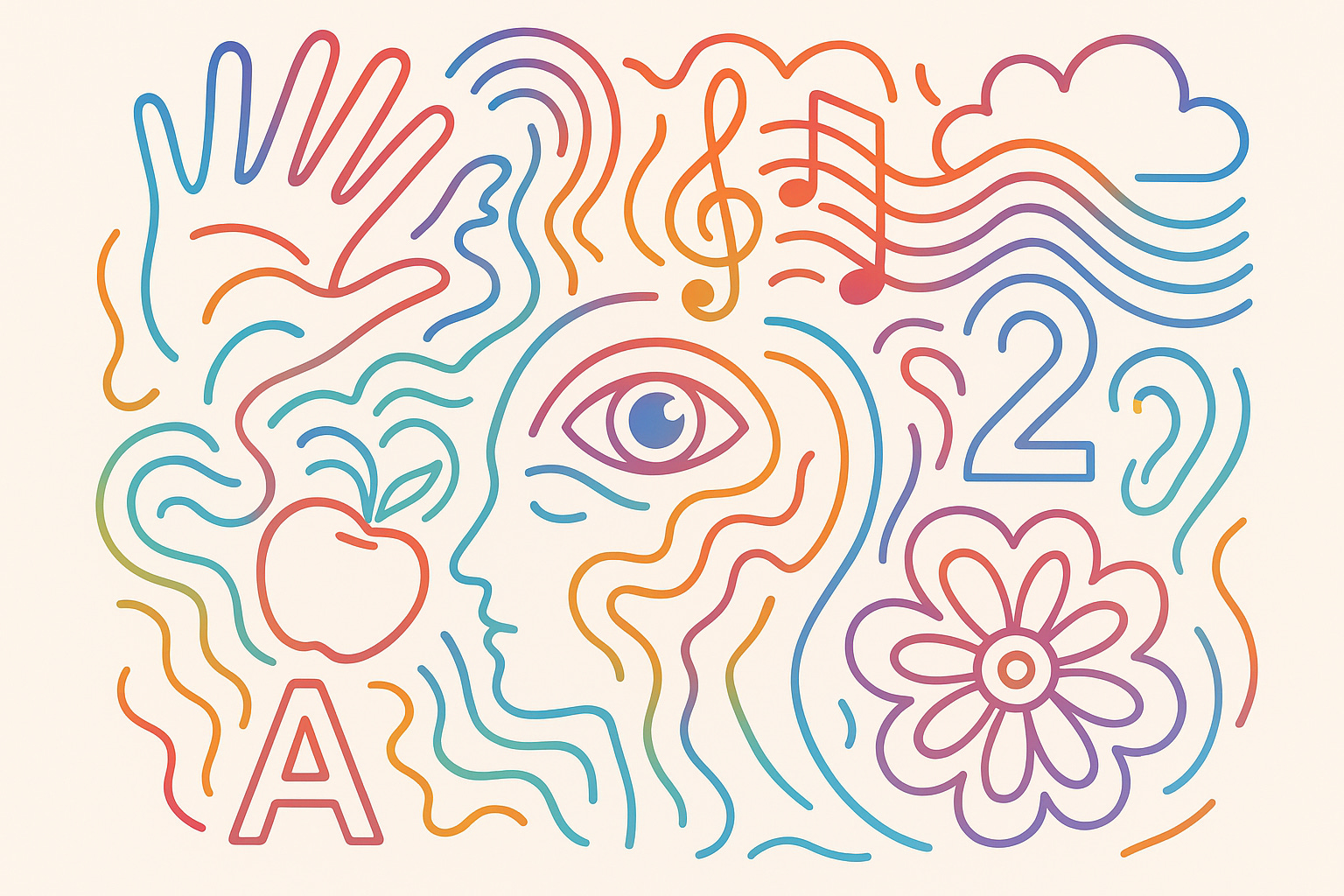
UNDERSTANDING SYNESTHESIA: A Cartography of the Unseen
Synesthesia occurs in many forms. Grapheme color synesthesia (letters or numbers triggering color) is the most widely studied. Other common variants include sound–color (music evokes visuals),

lexical–gustatory (words elicit tastes), number-form (numbers occupy spatial layouts),

and mirror-touch (observing touch produces a tactile sensation in the observer).

These variants offer different windows into multisensory integration and individual differences.
Two features make synesthesia scientifically Useful:
Automaticity: The concurrent arrives unbidden, like a reflex of perception. synesthetes do not decide to experience a color with “A.”
Consistency: The mappings are typically consistent across long intervals: letters, numbers, or tones usually map to the same concurrents when tested months or years apart. These properties allow researchers to collect repeatable behavioral labels that can serve as training data for AI models.
Prevalence estimates vary by definition and method. Conservative reviews place prevalence in the low single digits for strict definitions, while population surveys and large online cohorts reveal more nuanced distributions and possible learned components. For example, a large online sample (n = 6,588) shows evidence that some grapheme–color pairings can be learned or influenced by early exposure, which complicates a single prevalence number. Overall, synesthesia is sufficiently common to support group studies but still rare enough that careful recruitment and replication are necessary.
WHY AI IS A NATURAL COMPANION IN THIS JOURNEY
Synesthesia sits at the crossroads of the measurable and the ineffable. AI, with its capacity to parse complexity, is uniquely positioned to help us listen to the hidden music of perception.
1. Detecting Patterns in Neural Connectivity
Neuroimaging reveals whispers of structural differences: DTI and structural MRI studies show that grapheme–color synesthetes often have increased white-matter coherence in specific pathways, supporting a hyper-connectivity hypothesis. Machine learning methods can operate on connectivity matrices and anatomical features to identify which networks differentiate synesthetes from controls and which differentiate synesthesia subtypes. This turns imaging observations into testable, predictive features.
2. Predictive Classification of Synesthetic Mappings
Because synesthetic mappings are stable, they offer labeled examples: stimulus → concurrent. Supervised learning methods (random forests, SVMs, and deep neural networks) can be trained to predict reported concurrents from stimulus features, behavioral measures, and neural signatures. Work across cognitive neuroscience has shown that deep learning can decode task states and reconstruct stimulus content from fMRI and other neural data; this provides a technical precedent for attempting synesthesia prediction from imaging. These models allow hypotheses to move from description to prediction.
3. Generative Visualization of Synesthetic Experience
Conditional generative models (for example, conditional GANs) have been used as proof-of-concept for producing colorized letters and synesthesia-like outputs from achromatic input. Such generative outputs are valuable in two ways: they help operationalize subjective reports into visual artifacts researchers and They allow non-synesthetes to witness imitations of perceptual poetry and give synesthetes tools to articulate the ineffable.s
Together, these approaches form a research pipeline where AI becomes both microscope and paintbrush.
REAL-LIFE CASE STUDY: Daniel Tammet and the Geometry of Numbers
Real cases give research a human anchor and a clear test bed. Daniel Tammet, who reports vivid number-form synesthesia, recited 22,514 digits of pi on 14 March 2004, Daniel Tammet offers a rare window into number-form synesthesia. To him, numbers are entities—textured, shaped, emotional. This architecture of meaning enabled feats such as memorizing and reciting 22,514 digits of pi, not through rote mechanics but through intimate sensory landscape.
From a research perspective, Tammet’s case provides concrete benefits. His consistent mappings can serve as ground truth for training and evaluating models:If researchers can combine behavioral mapping data with neuro-imaging structural scans and task fMRI then a model could be trained to predict his reported concurrents from stimulus features and brain signals. Even if datasets from a single individual are small, the model can still provide mechanistic insight when paired with cross-participant validation. Where imaging does not show a simple signature, the divergence itself is informative: it suggests alternative network contributions (language, association cortex, memory networks) that models should include and that targeted imaging protocols should probe.
Even when models fail, they reveal new hypotheses: alternative pathways, hidden networks, unexpected collaborations between memory, language, and sensation.
AI APPLICATIONS AND REVERBERATIONS
AI-driven mapping could illuminate how the brain blends senses, builds meaning, and forms cross-modal associations, offering clues about perception, memory, and creativity.
Cognitive science: Mapping cross-sensory links can reveal how the brain integrates inputs and forms stable internal representations. Understanding these mechanisms sheds light on memory, creativity, and perception.
Educational tools: AI visualizations can be converted into learning aids. For example,multisensory mnemonics, color-tagged numeracy aides informed by synesthetic mappings could be tested for memory benefits in classroom settings.
Clinical research: Insights into multisensory wiring can inform research on neurodiverse populations (for example, variations in sensory integration in autism).
Careful, ethically designed studies might reveal whether certain multisensory patterns correlate with cognitive strengths or difficulties.

Public engagement and empathy: Generative visualizations translate private experience into shared artifacts that non-synesthetes can inspect, improving public understanding enabling empathy, wonder, and dialogue.
ETHICAL BOUNDARIES AND THE FRAGILITY OF THE SUBJECTIVE WORLD
Ethical guardrails. Brain and behavioral data are sensitive. Studies must secure informed consent, anonymize data, and avoid overstating model accuracy. Researchers must be transparent as consent and humility remain essential. Models must be tested rigorously, and their limits acknowledged openly.
The goal is not to decode souls but to illuminate patterns without violating the sanctity of inner life.
CHALLENGES AND LIMITATIONS
Major limitations must be emphasized. Synesthetic experience is still subjective: models cannot access qualia as Synesthetic qualia remain irreducibly subjective.; they can only map reported associations to measurable features. Synesthetes are relatively rare and heterogenous, creating small, noisy datasets that challenge model training and generalization. Neuroimaging data are high dimensional and noisy; careful preprocessing, feature selection, and explainable AI techniques are required to avoid spurious results. Finally, while generative models can produce convincing visualizations, validation must be human-centered: synesthetes themselves must judge whether outputs match lived experience. Thus, progress depends on careful replication, interdisciplinary dialogue, and an unwavering respect for the boundaries between computation and consciousness.
Conclusion
AI offers a pragmatic path from personal experience to scientific insight. By combining consistency-tested behavioral labels, neuroimaging, and machine learning, researchers can build models that map stimulus features and brain signals to synesthetic concurrents and produce visualizations that invite human validation.
Real cases, such as Daniel Tammet’s number-form synesthesia reminds us that behind every datapoint lies a world intricate, original, irreplaceable.
The field is emergent: meaningful progress will require multidisciplinary collaboration, rigorous methods, and careful ethical safeguards. Done right, AI-assisted synesthesia research will deepen our understanding of multi-sensory perception, memory, and creativity while honoring the human experiences that motivate the science.
Reflection: What Do Our Senses Say About Us?
To study synesthesia is to confront a deeper question:
Are we all, in our own ways, weaving hidden threads between experience and meaning?
AI may map neural pathways, detect statistical echoes, and reveal hidden harmonies, but it cannot experience the colors of letters or the shapes of numbers. It can only gesture toward the mystery.
Perhaps the true lesson of synesthesia is not that some people see differently—but that all perception is an act of creativity.
Question
If our senses are the instruments through which we compose reality, then what unseen symphonies are each of us already creating quietly, continuously, and without ever knowing?
© [Easy Weezy] 2025 |A Journal Of A Curious Mind X FavourOgoba
“If you find such topics interesting And enjoy reading my post, feel free to support my work by buying me coffee or upgrading to paid subscription thank you for your support, bye for now”
 |
|
It has been a pleasure collaborating with you
I’m inspired by your vision of the future. 🧠 ✨
The way you foreground ethics and empathy reads as the work of a genuinely compassionate professional. Using the tools we have at our disposal to support people, while remaining attentive to both their possibilities and their limits, feels grounded and holistic in ways that are too often missing from more casual or purely topical conversations about technology.
This piece has teeth and legs. Thank you for sharing. 🌱💜